A quiet morning
Choose an early visit if listening is your priority. Pause away from conversations, leave your headphones in your bag and let the notes emerge.

On the edge of Zadar’s old town, the Adriatic plays a melody that belongs to this moment alone. Take a seat. Stay a little longer.
At first, there is only the horizon. Then a low note rises through the stone, followed by another. You are listening to the Sea Organ of Zadar.
Known in Croatian as Morske orgulje, this sound installation turns the movement of the Adriatic into music. The instrument is hidden beneath the waterfront steps. Its rhythm follows the water: sometimes delicate, sometimes full and resonant. Give it a few unhurried minutes, and the promenade becomes a place to pause.
A minute by the water
Waves, resonant notes, the life of the waterfront. Hear a real recording of the Sea Organ.
Recorded by Zuse · 12 September 2014 · 1:02
Wikimedia Commons · CC0 · Open recording
Low, airy organ tones rise and fall over the sound of water and people on the promenade. This is a field recording, not a live stream.
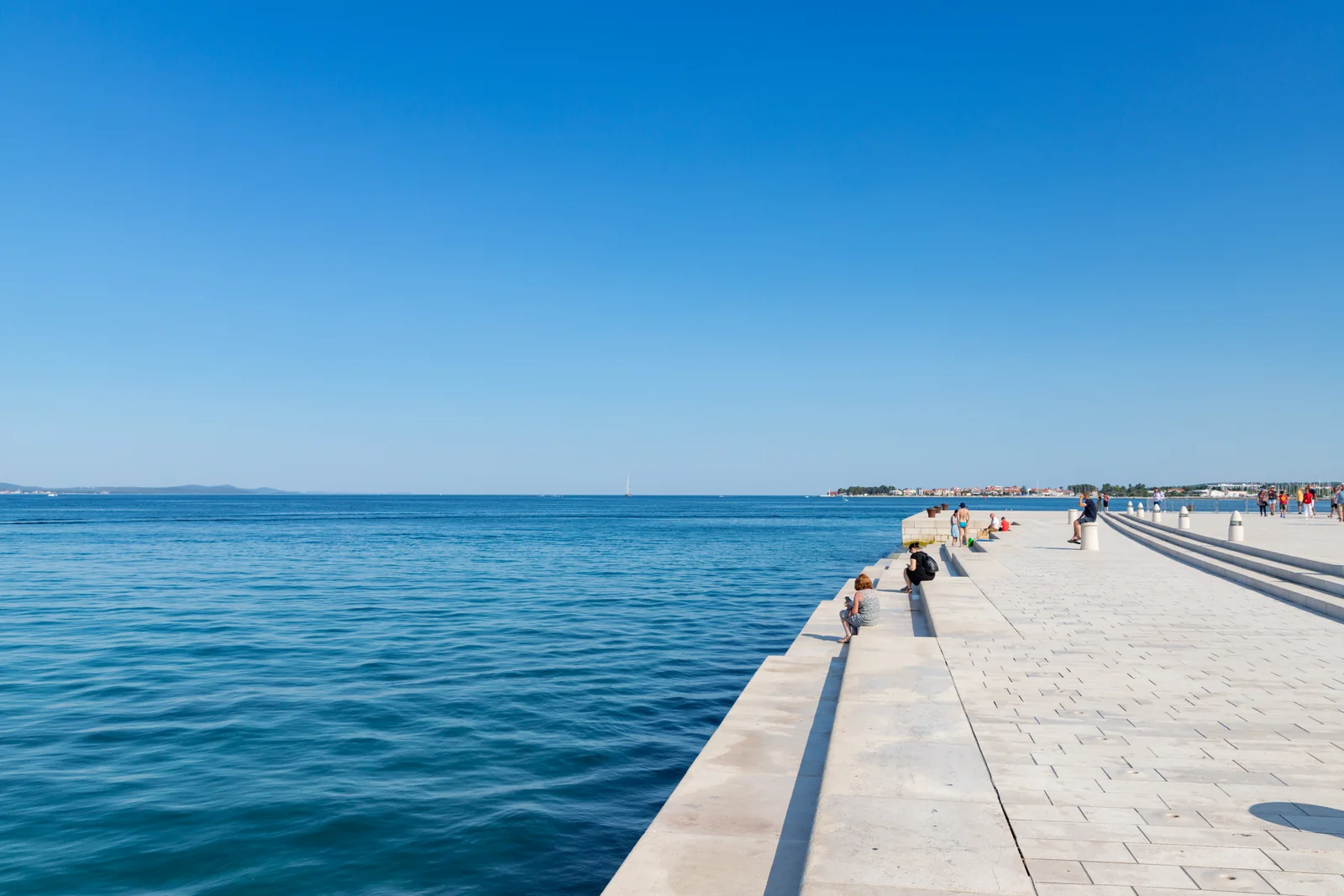
Designed by Croatian architect Nikola Bašić and opened in 2005, the Sea Organ gave this stretch of Zadar’s waterfront a new relationship with the water. The steps are both a public gathering place and the surface of an unusual musical instrument.
Beneath a waterfront section about 70 metres long, 35 pipes of different dimensions respond to the waves. Moving water pushes air through the system, producing tones that escape through openings in the stone. There is no fixed song or performance time: the sea shapes what you hear.
Read the source · Architectuul
How Zadar Sea Organ Works: Sound, Pipes & HistoryOur suggestion: visit twice, in different light. The sound and the atmosphere are never quite the same.
Choose an early visit if listening is your priority. Pause away from conversations, leave your headphones in your bag and let the notes emerge.
Arrive before the sun reaches the horizon, especially in summer. Bring patience for the crowds and leave room for others on the steps.
Stay for the nearby Greeting to the Sun. Its illuminated surface adds a second chapter to an evening spent beside the sea.
At the northwestern tip of Zadar’s old town peninsula, on Obala kralja Petra Krešimira IV, beside the Greeting to the Sun. Approach on foot along the waterfront.
The Sea Organ is a free public outdoor installation, generally accessible day and night. No ticket or reservation is needed; temporary local restrictions may apply.
Allow 20–30 minutes to sit and listen, or longer around sunset. This is our suggested visiting time, not a timed attraction or a scheduled show.
The upper promenade is accessible, but the lower steps are not independently wheelchair-accessible. Take care on wet stone and near the water; bring sun protection in summer.
From the Roman Forum, head to the Riva and follow the waterfront towards the northwestern tip of the peninsula. Use walking directions for your starting point; the promenade is part of the experience.
Check public parking around Liburnska obala or Ravnice, then continue on foot. Obala i lučice publishes parking zones, seasonal charges and payment options. Follow the signs at your chosen space.
For current access conditions, local advice or assistance, contact the Zadar Tourist Board. Check the weather before visiting the exposed waterfront. Accessibility information · +385 23 316 166
60–90 minutes · Our suggested route
Allow extra time for the light to change. The sequence is a suggestion; there is no scheduled performance.
Let the old town lead you towards the water.
Find a place on the steps or upper promenade and listen.
Stay nearby as daylight gives way to the illuminated circle.
Next to the Sea Organ, the Greeting to the Sun — Pozdrav Suncu — brings light to the waterfront after dark. Together, the two installations invite you to experience the same place through sound and colour.
Make an evening of it: wander through the old town, find your place along the promenade, then return to the narrow streets for dinner. Leave enough space in the plan for doing very little.
Explore more of Zadar
Visitor guides
Understand the sound, plan your arrival and find your moment on the waterfront.
Plan a visit to Zadar’s Sea Organ: free entry, day and night access, walking directions, parking information and wheelchair access to the upper promenade.
Read the guideUnderstand how waves create the sound of Zadar’s Sea Organ. Discover its 35 pipes, Nikola Bašić’s architecture, its 2005 opening and a real recording.
Read the guidePlan sunset at Zadar’s Sea Organ, choose a quieter listening time and combine the visit with the neighbouring Greeting to the Sun light installation.
Read the guideThe Sea Organ, or Morske orgulje, is a wave-powered sound installation built into the steps of Zadar’s waterfront. It was designed by Nikola Bašić and opened in 2005.
No. Listening to the Sea Organ is free and no booking is required. Paid guided tours are optional and are separate from access to the installation.
Choose the morning for a quieter visit or the sunset period for evening light. Sunset attracts more people, particularly in summer. The sound depends on sea conditions, not a timetable.
It responds to the movement of the water. The rhythm and volume vary with the waves; very calm conditions may make it quieter. It is not a recorded soundtrack.
The upper waterfront allows you to experience the sound without descending the steps. The lower levels do not provide independent wheelchair access. Ask the tourist board about the best approach for your needs.
No. They are neighbouring installations: the Sea Organ produces sound, while the Greeting to the Sun is a circular light installation best appreciated after dark.
Your next chapter
Beyond the waterfront: old town lanes, island horizons and more reasons to linger.
Discover ExploreZadar.travel